Your website needs a plot
Website storytelling for service businesses, from the homepage to the case study.

Jessie Borgmann
Founder, Dotted Octopus

When I bring up storytelling, some business owners picture a long About page that starts with "It all began in 2009..." That's not what I mean.
Website storytelling helps a potential customer see how your business fits into the future they want. They arrive with a problem, a goal, or a question. Your website needs to show that you understand their situation, explain how you can help, and make the next step feel manageable.
Two beliefs shape how I approach it. First, your customer is the main character, and your business is the guide who helps them get where they're going. (Donald Miller's StoryBrand framework puts this well.) Second, a good story makes the value clear: the outcome you deliver, the reasons to believe you can deliver it, and what getting there involves.
Your founder story can support all of that. But a visitor shouldn't have to read your entire history to figure out what's in it for them.
Where your website's story lives
Your story isn't confined to the homepage. Each page answers a different part of the customer's decision:
- Homepage: establish relevance. "You're in the right place. Here's how this business can help." (I wrote a whole post on giving your homepage a clear job.)
- About page: build the relationship. "Here's who you'll work with, what they believe, and why their experience matters to your situation."
- Service pages: make the offer clear. "Here's what you receive, how it helps, what the process involves, and what's expected of you."
- Case studies: provide evidence. "Here's how this approach worked in a specific situation."

Together, those pages move people from curiosity to confidence. The key is continuity. Visitors shouldn't have to restart the story every time they click. If your homepage talks about helping growing firms feel confident in their numbers, your services page and case studies should pick up that same thread.
How to find your story
Start with your customer's situation and work outward. These are the questions I ask:
- What makes someone realize they need your help?
- What are they trying to achieve?
- What have they already tried?
- What are they afraid could go wrong?
- What makes them hesitate before buying?
- What do you do that makes the process easier?
- What evidence can you show that supports your promise?
- What do clients say changed after working with you?
I'm listening for the connection between what the business provides and what the customer actually values.
Here's an illustration. A firm might say it sells bookkeeping services. Its customers might be looking for numbers they can understand, fewer unanswered questions, and more confidence making business decisions. That's the story. The catch is that you have to verify those priorities through real conversations with customers rather than assume them.
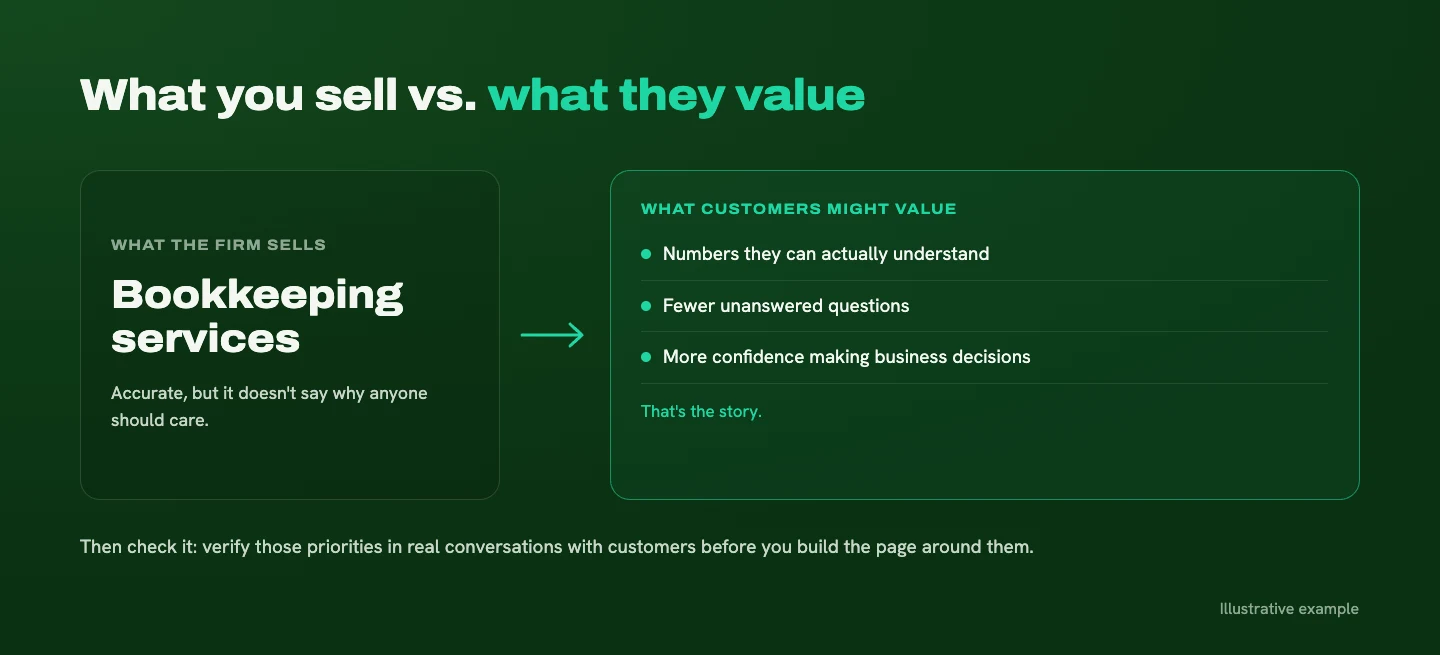
Done well, this gives you a much stronger story than a list of features or a polished slogan.
The customer is the hero. You're the guide.
The customer brings the goal. Your business brings guidance, expertise, and a clear way forward. I come back to that balance on every project. Your experience matters because it helps the customer trust you, not because every section of your website needs to prove how impressive you are.
Show that experience through relevant examples, thoughtful explanations, and specific decisions. Then connect it back to the person reading: here's what my approach means for you.

None of this requires hiding your personality. It comes through in your voice, your imagery, your values, and the way you work. You can be memorable and expressive while keeping the customer's needs at the center. (More on that in Your customer is the hero.)
How visuals tell the story
Visuals make the promise tangible and help people follow along.
- Photography can show the people visitors will work with, the environment they'll step into, or the kind of work they can expect.
- Illustration can explain something that's hard to photograph, like a process or an abstract service.
- Color and typography give the business a recognizable identity.
- Layout guides the order: what someone notices first, what supports that message, and where they can go next.

Here's a test I use: do the visuals help people believe the outcome is achievable? A relevant project example often reassures people more than a decorative image ever could.
On my own site, I want the design to express creativity while the structure keeps the message easy to understand. Both shape the impression of what working with me would feel like.
Case studies that read like stories
A list of deliverables says, "Here's what I made." A case study that tells a story explains why those things needed to be made and how they changed the situation.
I structure case studies around five beats:
- What the client wanted to accomplish
- What was getting in the way
- What informed the approach
- Which decisions mattered, and why
- What changed, supported by the evidence available
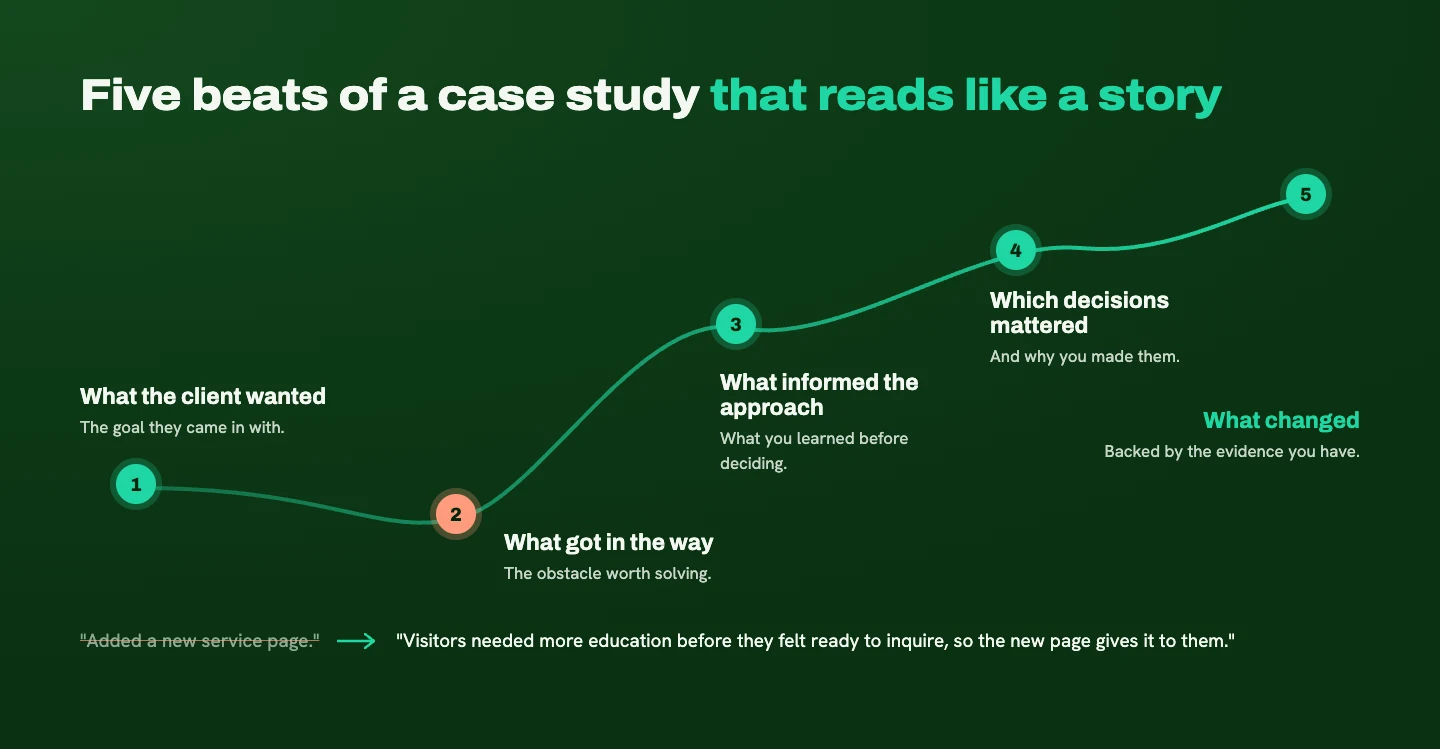
So instead of "Added a new service page," explain that visitors needed more education before they felt ready to inquire, and show how the new page gave it to them.
The reader should recognize something relevant to their own business. That's what helps them judge whether your experience applies to them. And if you don't have measured results, describe the completed changes accurately. A compelling story doesn't need an invented conversion increase.
Storytelling mistakes to watch for
Making the business the focus of every paragraph. Our history, our passion, our process, our excellence. Those details only matter once they're connected to the customer.
Presenting a service without its value. People can understand exactly what you deliver and still wonder why they should care.
Promises that skip the process. "Transform your business" sounds appealing, but visitors need to know what you'll actually do, what they'll contribute, and why they should believe you.
Making the problem unnecessarily dramatic. You can acknowledge frustration without turning every outdated website into a business emergency.

The story should feel specific, credible, and useful. Get to the point, support the promise, and make the next step clear.
How storytelling connects to SEO
Search shows you the questions that start the story. Someone searching "website refresh vs redesign" is in the middle of a decision. A helpful article meets them there: it helps them recognize their situation, compare their options, and understand a sensible next step.
Clarity matters here as much as anywhere: use language your customer recognizes. Name your services plainly, write descriptive headings, and answer the question before getting clever. Then let value shape the substance: what outcome matters to this reader, what uncertainty needs addressing, and what would make the decision easier?
Storytelling won't trick a search engine into ranking you. What it does is turn a relevant topic into content people find useful, and that works alongside a sound SEO structure and technical setup.
What this looked like for Loan Note Exchange
Loan Note Exchange helps people sell privately held mortgage notes, and its visitors arrive at very different stages of the decision. Some are ready to request an offer. Others still need to understand what a mortgage note is, how selling works, and whether it suits their situation.

So the website had to support both action and education. The story followed the customer's questions, with clear explanations along the way and opportunities to inquire whenever someone felt ready.
That's what I mean by website storytelling. The customer's decision drove the story, and the website's job was to guide them through it, making the value clear and taking the uncertainty out of the process.
Give your website a plot worth following
Beautiful design gets stronger when it tells a relevant story, gives people reasons to trust you, and helps them move forward. Start with your customer's situation, give every page a role in the story, and keep the thread connected from the first click to the inquiry.
If your website talks a lot about your business but not much about your customer, I'd love to help you find the story and carry it through every page. Tell me about your business, and we can start with the questions your customers are already asking.
Ready for a website that makes this easier?
Tell me about your business and your goals. I'll help you figure out what your website needs to say, and how to make it clear.
Start Your ProjectLiked this one? Get the next article in your inbox.
Your website should work as hard as you do. Each new article shows you where yours is quietly losing leads, trust, or attention, and exactly what to fix. It lands in your inbox the day it's published, and you can unsubscribe whenever you like.
You're on the list. Thanks for subscribing!
Something went wrong. Please try again in a moment.

A strategy-led design studio creating clear, thoughtful websites for B2B and professional-service businesses.
Start Your ProjectDotted Octopus
© 2026 Dotted Octopus. All Rights Reserved.
Back to top ↑